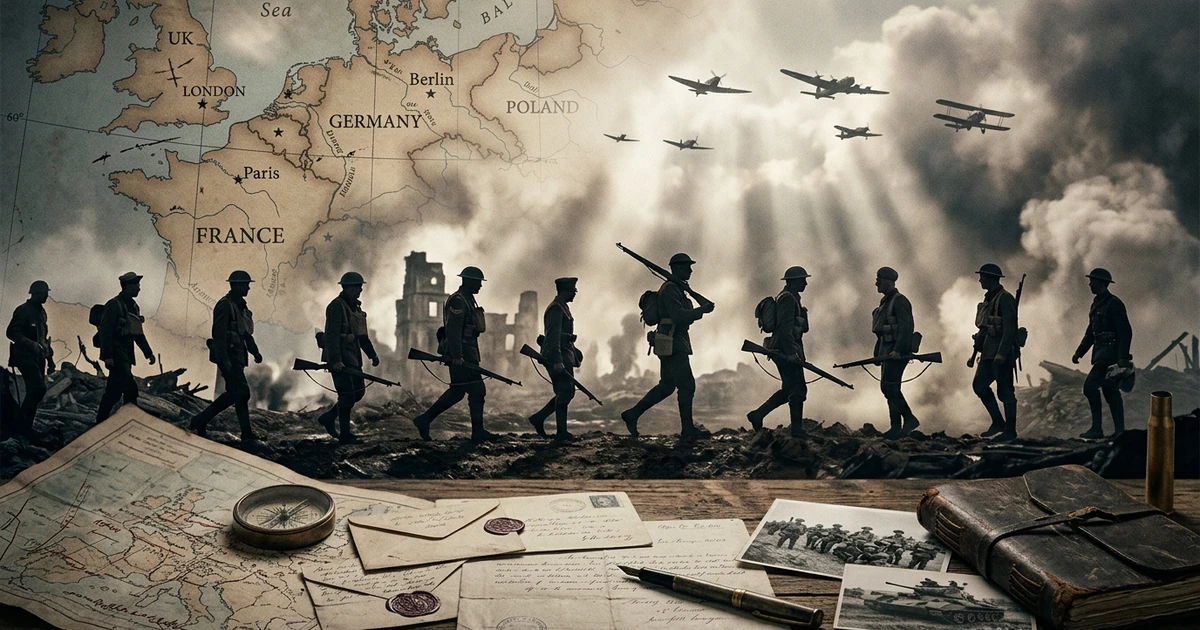
World War history begins with a hard question. How did regional rivalries become global conflict twice in one century? The First World War and Second World War changed politics, borders, technology, and daily life across continents. Their effects still shape diplomacy, education, military planning, and public memory today. This guide explains the causes, turning points, human impact, and lasting lessons of the world wars in clear language. For deeper context, you can also explore how technology changed warfare during the world wars.
Key Takeaways
-
World War history shows how alliances, nationalism, imperial rivalry, and economic pressure can turn local crises into global conflict.
-
The world wars transformed military technology, wartime propaganda, civilian life, and international institutions.
-
The legacy of global conflict remains visible in borders, national identities, remembrance culture, and modern security policy.
World War History Causes and the Road to Global Conflict
World War history shows that global conflict rarely starts from one event alone. Alliances, nationalism, militarism, imperial rivalry, economic pressure, and weak diplomacy created conditions where local crises became international emergencies. The road to war matters because it reveals how fear, ambition, and miscalculation can overwhelm compromise before leaders fully understand the consequences.
The First World War lasted from 1914 to 1918. It began after the assassination of Archduke Franz Ferdinand, but the deeper causes were far broader. European alliances, militarism, imperial competition, and nationalism created a fragile system. Once Austria Hungary moved against Serbia, alliance commitments pulled major powers into war. The Imperial War Museums account of how the world went to war in 1914 gives a useful overview of the early crisis and shows why the conflict spread so quickly across Europe and beyond.
The First World War grew from a dangerous balance of power. Germany feared encirclement. France wanted security after losing territory in 1871. Russia backed Slavic interests in the Balkans. Britain worried about naval rivalry and European stability. Each power believed preparation would prevent war, but it instead made war more likely.
The Second World War had different roots. The Treaty of Versailles punished Germany, but it did not create lasting stability. Economic crisis weakened democratic governments. Adolf Hitler used resentment, propaganda, and violence to build support. Japan expanded across Asia, while Italy pursued empire in Africa. The League of Nations lacked the strength to stop aggression.
A few patterns connect both conflicts:
-
National pride made compromise harder.
-
Military plans reduced time for negotiation.
-
Economic stress empowered extreme politics.
-
Weak international enforcement encouraged aggression.
-
Public opinion was shaped by fear and propaganda.
This is why the study of wartime propaganda matters. Governments used posters, films, speeches, newspapers, and radio to build support, demonise enemies, and control morale. For more detail, read about the role of propaganda in the world wars, which explains how public belief became part of national strategy.
What Made World War History So Transformative?
World War history was transformative because these wars changed societies as deeply as they changed battlefields. Governments mobilised industry, controlled information, expanded state power, and asked civilians to sacrifice on an unprecedented scale. The result was not only military victory or defeat, but a permanent shift in politics, public memory, technology, and international order.
The world wars did more than decide battlefield outcomes. They changed how states organised labour, used industry, managed information, and negotiated peace. Modern governments learned to mobilise entire populations, not only armies. Factories became strategic assets. Food, fuel, railways, newspapers, and radio became part of national war efforts. Civilians were no longer distant observers. They became workers, targets, witnesses, and symbols of national resilience.
Several factors made the world wars transformative:
-
Entire economies shifted toward war production.
-
Civilians became direct targets and active participants.
-
New weapons changed the scale of destruction.
-
Peace settlements redrew borders and created new tensions.
-
International organisations emerged to prevent another catastrophe.
The Second World War lasted from 1939 to 1945. Its causes included the harsh settlement after the First World War, the rise of fascist regimes, economic instability, and failed appeasement. Germany invaded Poland in 1939, which led Britain and France to declare war. Japan, Italy, the Soviet Union, the United States, China, and many other nations became central to the conflict.
How World War Changed Military Technology
World War history is closely tied to innovation under extreme pressure. Tanks, aircraft, submarines, radar, codebreaking, and industrial logistics changed how nations fought and how civilians experienced danger. These tools reshaped strategy, production, communication, and national security, proving that modern war depends on science, factories, intelligence, and coordination as much as battlefield courage.
Military technology advanced rapidly during both conflicts. In the First World War, machine guns, heavy artillery, poison gas, aircraft, tanks, and submarines changed combat. Trench warfare showed the deadly gap between old tactics and modern weapons. Armies struggled to adapt as defence often proved stronger than attack. The Second World War brought faster movement and wider destruction, with tanks and aircraft working together in mobile campaigns. The National WWII Museum overview of World War II offers strong educational context on the scale, strategy, and consequences of the conflict.
The Second World War also expanded the role of intelligence and communications. Radar helped detect incoming planes. Codebreaking shaped battlefield decisions. Aircraft carriers changed naval warfare. Strategic bombing targeted industrial centres and cities. The atomic bomb introduced a new age of destructive power. These developments connected universities, factories, scientists, soldiers, and governments in ways that still influence defence planning today.
Important technological shifts included:
-
Tanks helped break trench deadlock and later enabled fast armoured warfare.
-
Submarines threatened supply routes and changed naval strategy.
-
Radar gave defenders early warning against air attack.
-
Encryption and codebreaking made intelligence a battlefield.
-
Mass production linked factory output directly to military power.
Military innovation also changed how nations measured strength. It was no longer enough to have brave soldiers or strong commanders. Countries needed steel, oil, engineers, pilots, shipyards, laboratories, and reliable supply chains. This link between industry and strategy is one of the most important lessons in World War history.
World War History in the Air War
World War history in the air shows the speed of military change. Aircraft moved from scouting roles in 1914 to strategic bombing, carrier warfare, radar guided defence, and fighter campaigns by 1945. Air power changed naval strategy, city life, civilian risk, and the way governments measured industrial strength during long conflicts.
One clear example is air warfare. In 1914, aircraft mainly scouted enemy positions. By 1945, bombers could devastate entire cities, while fighters battled for control of the skies. The Battle of Britain showed how radar, pilots, aircraft production, and civilian resilience could decide a campaign. Air power also changed public experience, because cities became targets and civilians lived with sirens, shelters, blackouts, and fear from above.
The air war also reshaped naval strategy. Aircraft carriers became central to campaigns across the Pacific. Long range bombers expanded the reach of military power. Fighter planes protected troops, shipping, and industrial centres. You can learn more through the air war fighter planes and bombing campaigns, which explores how aircraft changed tactics and national morale.
Civilian Life, Borders, and the Long Legacy of World War
World War history cannot be understood only through generals and battles. Civilians rationed food, worked in factories, endured bombing, faced occupation, and rebuilt shattered communities. The same conflicts also redrew borders, collapsed empires, displaced millions, and reshaped national identities, making the human legacy of war visible in homes, maps, museums, and remembrance ceremonies.
The world wars blurred the line between battlefield and home front. Civilians worked in factories, rationed food, bought war bonds, joined civil defence, and endured bombing. Their labour and morale became essential resources. This shift made modern war a society wide experience rather than a purely military contest. During the First World War, families faced food shortages, grief, censorship, and uncertainty. Women entered factories, transport roles, hospitals, and farms in large numbers, challenging older ideas about gender and citizenship.
In the Second World War, the home front became even more central. Cities faced bombing. Governments rationed food, fuel, and clothing. Children were evacuated in some countries. Millions of people were displaced, imprisoned, or murdered. The Holocaust remains one of the darkest crimes in human history, showing where racist ideology and state violence can lead.
Daily life during global conflict often included:
-
Ration books and strict rules on consumption.
-
Blackout curtains to reduce bombing targets.
-
Factory shifts focused on weapons and supplies.
-
Letters from soldiers that connected home and front.
-
Public ceremonies that honoured loss and service.
Wartime propaganda shaped how people understood sacrifice. Posters asked citizens to save resources, keep secrets, work harder, and distrust the enemy. Radio speeches built morale. Films presented national purpose. Some messages encouraged unity, while others spread hate and dehumanisation.
The home front also changed politics. Many citizens expected better healthcare, housing, education, and employment after sacrifice. In several countries, the postwar period brought welfare reforms and new debates about social rights.
The legacy of World War history is also visible on maps. The First World War helped end the German, Austro Hungarian, Ottoman, and Russian empires. New states appeared in Europe and the Middle East, but many borders were contested. Some communities gained self rule, while others felt ignored or divided. These unresolved questions shaped later conflicts.
The Second World War changed global power even more. The United States and Soviet Union emerged as superpowers. Germany was divided after defeat. The United Nations was created to support international peace and cooperation. Decolonisation accelerated in Asia, Africa, and the Middle East as imperial authority weakened.
The border changes were not just lines on a map. They affected families, languages, citizenship, property, and identity. Population movements after 1945 were massive. Millions of people became refugees or were forced from their homes. To explore this theme further, read about how the world wars changed global borders.
World War memory also differs across countries. Some nations focus on victory and liberation. Others focus on occupation, genocide, defeat, resistance, or civilian suffering. These memories influence diplomacy and education today.
Modern lessons from the world wars include:
-
Alliances need clear communication and careful crisis management.
-
Economic humiliation can create political danger.
-
Propaganda can normalise hatred if left unchallenged.
-
Civilian protection must remain central during conflict.
-
International cooperation matters before crises become wars.
Final Thoughts on World War History
World War history remains essential because it shows the cost of failed diplomacy, aggressive nationalism, and unchecked violence. It also shows courage, resilience, innovation, and the struggle to rebuild. The best reason to study these conflicts is not fascination with war, but a clearer commitment to recognising warning signs and protecting peace.
The World War era reshaped the modern world through conflict, technology, propaganda, border changes, and civilian sacrifice. The First World War destroyed old empires and exposed the dangers of alliance politics. The Second World War revealed the catastrophic power of ideology, industrial warfare, and racial hatred. Yet both conflicts also produced lessons about cooperation, remembrance, and human rights. Studying World War history helps us recognise warning signs early and value peace more seriously. Continue learning through related topics such as how technology changed warfare during the world wars.