Author: leadmetrics

  • AI in eCommerce Checkout Optimization for Retail Enterprises

    AI in eCommerce Checkout Optimization for Retail Enterprises

    alt text# AI in eCommerce Checkout Optimization for Retail Enterprises

    AI in eCommerce is no longer a future concept for large retail enterprises. It is becoming a practical way to reduce checkout friction, recover lost revenue, improve customer experience, and connect marketing activity to measurable ROI. For CEOs, CTOs, IT Directors, and digital commerce leaders, the ecommerce checkout is one of the most important revenue control points. Retail teams can also connect checkout insights with broader digital growth through an AI driven marketing audit. This guide explains how enterprise retailers can use AI, automation, data, and optimization workflows to improve checkout performance at scale.

    Key Takeaways

    Enterprise checkout performance depends on much more than page design. AI helps retailers understand buyer behavior, payment failures, fraud signals, campaign quality, and customer effort in one connected view. For large retail enterprises, this creates a clearer path to higher conversion, stronger lead generation, better media ROI, and faster revenue protection.

    1. AI in eCommerce helps large retailers personalize checkout flows, predict abandonment, detect fraud, and improve payment success.

    2. A stronger ecommerce checkout needs clean data, faster pages, targeted recovery journeys, and continuous experimentation.

    3. An ai ecommerce business can connect checkout optimization with digital marketing, paid media, landing pages, lead generation, and ROI reporting.

    Why AI in eCommerce Matters for Checkout Growth

    Large retail enterprises often invest heavily in traffic generation, paid media, SEO, social media, and marketplace visibility, yet lose revenue at the final checkout step. AI in eCommerce helps teams identify the exact friction points that affect conversion, then improves decisions across personalization, payment routing, fraud checks, recovery automation, and ROI reporting.

    Checkout is where marketing spend either becomes revenue or wasted opportunity. A retailer can run high intent Google Ads, publish social media campaigns, and rank for product searches, but a slow or confusing checkout will reduce returns from every channel.

    According to Baymard Institute cart abandonment research, many online shopping carts are abandoned before purchase. For enterprise retailers, even a small reduction in abandonment can produce significant revenue impact because traffic volumes are high.

    AI improves this process by analyzing customer behavior in real time. It can detect hesitation, device friction, payment failure patterns, delivery cost sensitivity, and repeat customer intent. Instead of relying only on static checkout rules, retail teams can use predictive insights to adjust the experience dynamically.

    For example, a returning customer may see saved addresses and preferred payment options first. A price sensitive customer may receive clearer delivery information earlier. A high risk transaction may trigger stronger verification without slowing every shopper.

    This is where digital marketing and checkout optimization must work together. If campaigns bring qualified users to product pages, checkout intelligence should complete the journey. Platforms such as Leadmetrics help businesses connect digital marketing, landing page optimization, performance analysis, and lead generation into a measurable growth workflow.

    How AI Identifies and Personalizes Ecommerce Checkout Friction

    AI can analyze thousands or millions of customer sessions to uncover patterns that human teams often miss. It helps enterprise retailers understand where shoppers pause, drop off, change payment methods, abandon delivery options, or repeat failed actions during the ecommerce checkout journey, then apply personalization that reduces effort without adding complexity.

    Large retailers usually have complex checkout systems. They manage multiple regions, currencies, payment gateways, tax rules, delivery partners, loyalty programs, coupons, guest checkout flows, and mobile app experiences. Manual analysis can miss hidden friction.

    AI models can review checkout data across:

    1. Page load speed

    2. Payment failure rates

    3. Coupon error frequency

    4. Delivery charge shock

    5. Device and browser issues

    6. Login and password reset friction

    7. Address validation failures

    8. Cart value changes before payment

    9. Fraud review delays

    10. Customer service escalations

    These signals help teams prioritize improvements based on revenue impact, not guesswork.

    AI in eCommerce Data Signals That Reveal Revenue Leakage

    AI in eCommerce gives retail leaders a practical way to connect checkout actions with business outcomes. Instead of only reviewing broad conversion reports, teams can see which customer segments, devices, campaigns, payment methods, and form fields create revenue leakage, then focus technical and marketing resources on the highest value fixes first.

    For example, AI may find that mobile users from paid campaigns abandon checkout after seeing delivery charges. The issue may not be ad quality. It may be the timing of shipping cost visibility. Another segment may abandon after coupon validation errors, which points to a technical issue rather than weak demand.

    Google also recommends improving user experience metrics such as loading performance and interactivity through Core Web Vitals guidance. AI can support this by connecting page speed data with conversion outcomes, then helping teams prioritize the highest value fixes.

    An ai ecommerce business should treat checkout as a live optimization system. It should not be reviewed only during redesign cycles. With AI powered software, teams can monitor checkout behavior continuously and improve outcomes faster.

    AI in eCommerce Personalization for Enterprise Buyers

    AI in eCommerce personalization helps retailers adapt checkout experiences to customer intent, history, device, location, and risk level. For large enterprises, this creates faster journeys for loyal customers and clearer guidance for shoppers who need more confidence before payment, while keeping the ecommerce checkout simple, secure, and conversion focused.

    A one size fits all checkout flow creates unnecessary friction. Enterprise retailers serve many customer types, including first time buyers, loyalty members, corporate buyers, discount seekers, mobile shoppers, repeat subscribers, and high value customers.

    AI can personalize checkout in practical ways:

    1. Show the most used payment method first

    2. Preselect the best delivery option based on past behavior

    3. Offer guest checkout to first time shoppers

    4. Highlight loyalty points for existing customers

    5. Detect when a customer needs support

    6. Trigger cart recovery based on predicted purchase intent

    7. Recommend relevant add ons without distracting from payment

    The goal is not to overload the checkout page. The goal is to reduce effort.

    For instance, a loyal customer who buys every month should not face the same steps as a new visitor. AI can identify that customer, simplify the flow, and surface stored preferences. At the same time, a first time shopper may need trust signals, easy returns information, and payment security cues.

    Personalization should also align with landing page and campaign intent. If a customer enters through a product specific campaign, the checkout flow should preserve message consistency. Retail teams can improve this journey by using conversion focused pages, such as the Leadmetrics guide to launch landing pages that generate qualified leads. Strong landing pages and checkout flows work together to increase conversion efficiency.

    Building an AI Ecommerce Business Checkout Workflow

    An ai ecommerce business needs more than tools. It needs a structured workflow that connects data collection, customer segmentation, checkout testing, payment optimization, fraud intelligence, and marketing ROI. This allows leadership teams to make better decisions across technology, operations, finance, and revenue generation while keeping every improvement tied to measurable commercial value.

    Enterprise checkout optimization should begin with clear business questions. Where do shoppers abandon? Which customer segments convert best? Which campaigns send high intent users? Which payment methods fail most often? Which checkout changes improve revenue without increasing risk?

    A practical AI checkout workflow includes five stages.

    1. Connect data across commerce and marketing

    Retail enterprises should connect data from ecommerce platforms, CRM systems, payment gateways, ad platforms, analytics tools, social media campaigns, and customer support systems. AI performs better when it can see the full journey.

    This helps leaders understand whether the issue starts with traffic quality, product page messaging, checkout design, payment failure, or post click expectations.

    1. Segment checkout behavior

    AI can group shoppers by behavior instead of only demographics. Segments may include fast buyers, hesitant buyers, coupon dependent buyers, high value loyal customers, mobile only shoppers, and payment sensitive users.

    Each segment may need a different checkout improvement.

    1. Prioritize revenue impact

    Not every checkout issue deserves equal attention. AI can estimate which fixes may protect the most revenue. A small improvement in payment success may matter more than a cosmetic design update.

    1. Run controlled experiments

    Retailers should test checkout changes carefully. This includes testing button placement, address forms, delivery timing, guest checkout, payment ordering, trust signals, and cart recovery prompts.

    1. Connect results to ROI

    Every checkout improvement should connect to revenue, cost savings, customer lifetime value, and marketing ROI. This is where enterprise leadership gains confidence.

    Leadmetrics supports businesses with AI powered digital marketing, campaign optimization, automation, and reporting. Retail teams that want to connect checkout insights with acquisition performance can explore Google Ads optimization and digital performance workflows to reduce wasted media spend.

    Speed, Payments, Fraud Control, and Marketing ROI

    Checkout success depends on speed, payment reliability, trust, and the quality of traffic entering the funnel. AI helps large retailers detect technical issues, route payments intelligently, reduce false fraud declines, improve customer confidence, and connect ecommerce checkout insights with SEO, paid media, social media, AI search, and lead generation.

    Speed directly affects conversion. A slow checkout creates frustration, especially on mobile. AI can identify which pages, scripts, devices, and locations create the biggest delays. It can also help teams predict the revenue impact of speed improvements.

    Payment optimization is another major opportunity. Large retailers often use multiple payment gateways, wallets, cards, buy now pay later options, and regional payment methods. AI can monitor approval rates and route transactions based on success probability.

    For example, if one gateway underperforms for a specific bank or region, AI can recommend routing similar transactions through another provider. This can improve authorization rates without changing the customer experience.

    Fraud control also benefits from AI. Traditional fraud rules may block legitimate customers. AI can score risk more precisely by reviewing transaction patterns, device signals, purchase history, location, and behavior. This reduces false declines while protecting the business.

    A balanced AI fraud strategy should:

    1. Reduce unnecessary manual reviews

    2. Detect unusual transaction patterns

    3. Protect loyal customers from false declines

    4. Trigger stronger checks only when needed

    5. Keep checkout fast for low risk shoppers

    Enterprise teams should also monitor how fraud actions affect marketing performance. If high intent paid traffic gets blocked during checkout, media ROI suffers. This is why checkout data should connect with campaign analytics.

    AI in eCommerce also supports customer support automation. If a shopper faces a payment issue, AI can trigger live chat, WhatsApp support, email recovery, or a tailored offer. The result is better customer experience and stronger lead recovery.

    AI in eCommerce Metrics Leaders Should Track

    AI in eCommerce metrics help CEOs, CTOs, IT Directors, and Vice Presidents measure what changed, why it changed, and how each improvement affects ROI. A shared dashboard should connect conversion, payment success, customer effort, campaign quality, fraud outcomes, recovery revenue, and operational efficiency across teams.

    Large enterprises need shared metrics across commerce, technology, marketing, finance, and operations. Without common reporting, teams may optimize in different directions.

    Important metrics include:

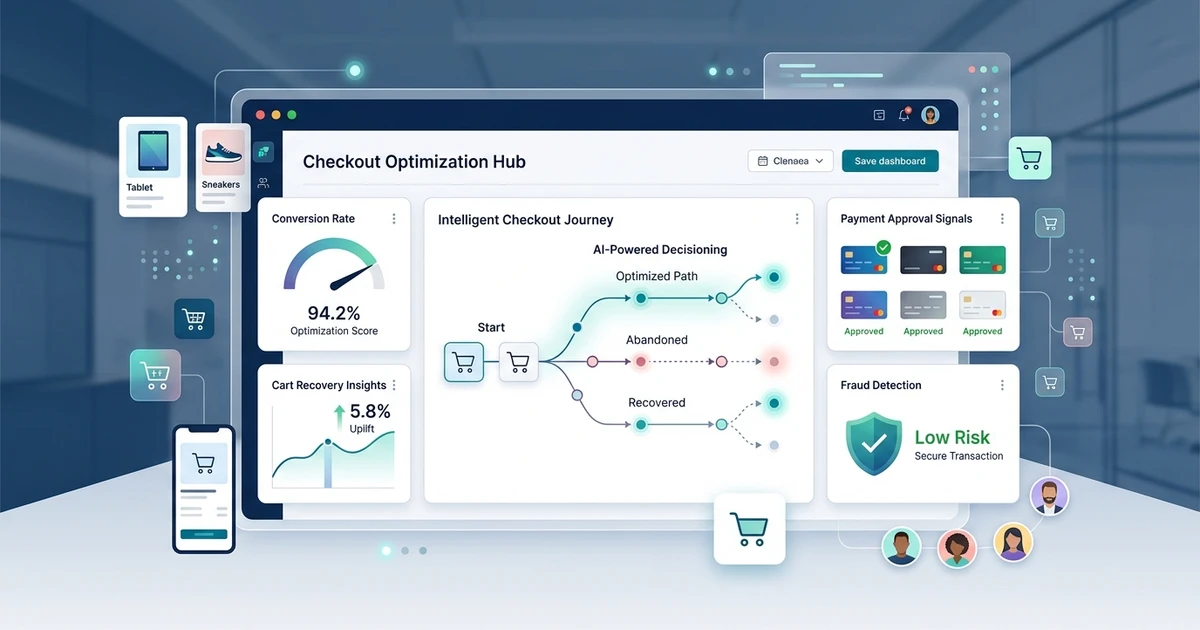
    1. Checkout conversion rate, which measures the percentage of users who complete checkout and shows direct revenue performance.

    2. Cart abandonment rate, which shows how many users leave before purchase and highlights lost opportunity.

    3. Payment approval rate, which reveals gateway, wallet, bank, and payment method issues.

    4. Average order value, which tracks upsell value and overall revenue quality.

    5. Mobile checkout conversion, which highlights device experience quality for mobile shoppers.

    6. Fraud false decline rate, which helps protect legitimate orders and customer trust.

    7. Recovery revenue, which measures the impact of abandoned cart journeys and automation.

    8. Campaign to checkout ROI, which connects digital media spend to completed revenue.

    Leadership teams should review these metrics weekly or monthly, depending on transaction volume. High volume retailers can use AI alerts to detect sudden drops in checkout performance.

    For example, if payment approval falls in one market, AI can alert finance and technology teams before the issue becomes a major revenue loss. If paid traffic conversion drops, marketing can adjust campaigns quickly.

    Checkout optimization becomes more powerful when connected to AI search optimization, SEO, paid media, social media, and landing page performance. Large retailers can improve the full funnel by attracting qualified shoppers, aligning messaging with buyer intent, and using checkout intelligence to guide future marketing decisions.

    Many retailers separate acquisition teams from checkout teams. This creates blind spots. Marketing may celebrate traffic growth while commerce teams struggle with conversion loss. AI helps close this gap.

    If checkout data shows that certain campaigns convert poorly, the problem may be audience targeting, landing page mismatch, pricing clarity, or product availability. AI can analyze these relationships and suggest better marketing actions.

    For example:

    1. If mobile paid traffic abandons at address entry, simplify mobile forms.

    2. If organic traffic converts better, expand SEO and AI search content.

    3. If social media traffic needs more trust, improve pre checkout proof.

    4. If coupon traffic has low margin, refine promotional targeting.

    5. If a product page drives high carts but low payment, review pricing and delivery clarity.

    AI search is also becoming important for retail discovery. Customers increasingly use AI assistants and generative search experiences to compare products, stores, delivery options, and reviews. Retailers should optimize content so AI systems can understand product value, availability, service areas, and trust signals.

    Leadmetrics offers AI search optimization to help businesses improve visibility across generative AI platforms and search experiences. For an enterprise retailer, this can support the full path from discovery to checkout.

    An ai ecommerce business should not see checkout as a technical endpoint only. It is a source of intelligence for media planning, SEO, product content, customer segmentation, and lead generation.

    Conclusion

    AI checkout optimization is now a practical enterprise growth lever, not a technical experiment. Retail leaders can use AI in eCommerce to improve speed, personalization, payment success, fraud control, campaign ROI, and customer experience while building a more data driven digital commerce operation that supports measurable revenue growth.

    AI in eCommerce gives large retail enterprises a smarter way to improve the ecommerce checkout without relying on guesswork. The strongest results come when checkout data connects with marketing automation, media performance, landing page optimization, AI search visibility, and ROI reporting. For CEOs, CTOs, and digital leaders, the next step is to identify where revenue is leaking and prioritize improvements with data. To explore how AI powered software can support your digital growth strategy, contact the Leadmetrics team.

  • Pooja AI Digital Marketing Guide for Lead Generation

    Pooja AI Digital Marketing Guide for Lead Generation

    AI Digital Marketing is changing how businesses attract, engage, and convert customers. Many teams still manage SEO, paid ads, social media, maps, content, and reporting through separate tools. That creates delays, wasted spend, and unclear ROI. This guide explains how AI can bring strategy, execution, automation, and performance analysis into one practical workflow. You will learn how AI powered software improves lead generation, reduces manual work, and helps decision makers optimize digital marketing with better data.

    Key Takeaways

    1. AI Digital Marketing helps businesses automate campaigns, improve targeting, and convert more qualified leads.
    2. The biggest value comes from connecting SEO, paid media, social media, maps, AI search, CRM, and reporting.
    3. A unified AI powered platform can help business owners track ROI and reduce marketing waste across channels.

    Why AI Digital Marketing Matters Now

    AI Digital Marketing matters because buyers now discover brands across search engines, social platforms, maps, ads, and AI answer engines. Businesses need faster execution, better data, and stronger optimization to stay visible. AI helps marketing teams act on signals from multiple channels and turn fragmented activity into measurable lead generation outcomes.

    A CEO may ask a simple question: “Which digital marketing activity created our best leads this month?” In many businesses, the answer is hard to find. SEO data sits in one place, paid media data in another, and lead details often live inside spreadsheets or disconnected CRM tools.

    AI changes this by connecting campaign activity with business outcomes. It can identify which keywords, locations, audiences, landing pages, and content formats create qualified leads. It can also recommend changes faster than manual analysis.

    This is especially important as search behaviour changes. People now use Google, Bing, ChatGPT, Gemini, Meta AI, and other AI assistants to research products and services. If your business is not optimized for both traditional search and AI search, you may lose visibility before customers reach your website.

    Research from McKinsey Global Institute shows that generative AI can create major productivity gains across business functions, including marketing and sales. For business owners, that means AI is no longer only a content tool. It is becoming a growth system.

    Leadmetrics AI positions this shift around practical execution. Its AI powered software supports SEO, paid ads, maps optimization, social media, AI search optimization, CRM workflows, and ROI analysis. You can explore the broader platform through its AI powered digital marketing software page.

    How AI Digital Marketing Improves Lead Generation

    AI improves lead generation by combining audience insights, campaign automation, landing page optimization, and CRM tracking. Instead of only increasing traffic, it helps businesses understand which users are most likely to convert. This allows marketing teams to focus budget, content, and follow up efforts on leads with stronger commercial intent.

    Lead generation fails when campaigns attract attention but not intent. A high traffic blog post, social campaign, or ad may look successful, but it only matters if it creates inquiries, calls, demo requests, or qualified sales conversations.

    AI Digital Marketing improves this process in four ways.

    1. It studies user intent across search, ads, social media, and website behaviour.
    2. It helps create tailored content for each stage of the buyer journey.
    3. It supports campaign optimization based on lead quality, not only clicks.
    4. It connects marketing activity to CRM records and ROI reports.

    For example, a real estate business may receive many paid ad inquiries, but only some users are ready to book a site visit. AI can help identify the best performing keywords, audience segments, locations, and landing pages. The team can then shift budget toward campaigns that generate stronger buyer intent.

    The same approach works for healthcare, education, retail, financial services, construction, tourism, logistics, and SaaS businesses. Each sector has a different customer journey, but the goal remains the same: attract the right audience and convert them into measurable leads.

    Leadmetrics AI also connects lead generation with performance analysis. Its approach helps decision makers understand cost, channel contribution, and ROI. You can read more in this related guide on AI lead generation for businesses.

    A strong lead generation workflow should answer these questions:

    1. Which channel created the lead?
    2. Which campaign influenced the inquiry?
    3. Which content or landing page supported conversion?
    4. What was the cost per qualified lead?
    5. Which leads moved forward in the sales pipeline?

    When these answers are visible, marketing becomes more predictable.

    AI Digital Marketing Channels to Optimize First

    The best AI Digital Marketing results come from optimizing high impact channels first. Most businesses should begin with SEO, paid media, social media, maps, and AI search because these channels influence discovery and demand generation. Once connected, they create a stronger path from visibility to inquiry, follow up, and revenue tracking.

    Businesses often try to improve everything at once. That usually creates scattered effort. A better approach is to prioritize channels that directly affect digital visibility and lead generation.

    Start with these areas.

    1. Search engine optimization

    SEO builds long term visibility. AI can support keyword research, content planning, technical recommendations, internal linking, and performance monitoring. It can also identify content gaps that competitors already rank for.

    Leadmetrics offers AI driven search engine optimization to help businesses improve organic discoverability across Google and Bing.

    1. AI search optimization

    AI assistants are becoming discovery platforms. Customers may ask ChatGPT, Gemini, or Bing Copilot for recommendations before visiting a website. This creates a new optimization challenge.

    AI search optimization focuses on structured content, clear entity signals, conversational answers, and trusted digital presence. The goal is to make your business easier for AI systems to understand and reference. Leadmetrics explains this through its AI search optimization feature.

    1. Paid media optimization

    Paid ads can generate leads quickly, but they can also waste budget quickly. AI helps analyze search terms, audiences, creatives, placements, and conversion patterns. This improves budget allocation and reduces spend on low quality clicks.

    For example, a clinic may discover that certain location based campaigns produce patient inquiries at a lower cost. AI can recommend shifting more budget into those campaigns while reducing weak segments.

    1. Maps and local visibility

    Maps optimization is essential for local businesses, healthcare providers, real estate offices, restaurants, education centres, and service companies. AI can help improve Google Business Profile content, location signals, reviews, categories, and local search relevance.

    1. Social media optimization

    Social media supports trust, recall, and engagement. AI can help generate content ideas, schedule posts, monitor performance, and align messaging with search and paid media campaigns.

    According to Think with Google, AI and automation can help marketers respond faster to customer signals. This is valuable because customer journeys are no longer linear. A buyer may see a social post, search your brand, check maps, compare reviews, and then submit a lead form.

    The winning strategy is not one channel. It is connected optimization.

    Building a Data Driven Digital Marketing Workflow

    A data driven digital marketing workflow connects planning, execution, optimization, and reporting. AI makes this workflow faster by turning campaign data into actions. Instead of reviewing reports after the month ends, teams can make timely improvements across content, ads, social media, maps, and lead management.

    The most effective AI Digital Marketing workflows follow a clear sequence. They do not treat AI as a random content generator. They use AI to improve the full marketing system.

    A practical workflow looks like this.

    1. Audit current digital presence

    Review SEO performance, paid media results, social activity, maps visibility, website conversions, lead sources, and CRM data. This creates the baseline for optimization.

    Leadmetrics offers a digital audit pathway through its marketing audit page.

    1. Build an AI assisted strategy

    Use business goals, audience data, location focus, competition, and channel performance to create a custom strategy. This strategy should define what to improve first and how success will be measured.

    1. Execute across connected channels

    Publish SEO content, optimize ads, improve maps listings, schedule social media, enhance landing pages, and prepare AI search friendly content. The goal is consistent digital presence across every discovery point.

    1. Capture and classify leads

    Every lead should be tracked by source, campaign, page, and intent. A mini CRM or connected CRM helps sales teams follow up faster and more accurately.

    1. Analyze ROI and optimize

    Use performance reports to identify what created qualified leads. Then adjust budget, messaging, content, and landing pages based on real outcomes.

    This workflow helps founders, CTOs, IT directors, entrepreneurs, and business owners make better decisions. It also reduces dependence on guesswork. Instead of asking whether marketing is working, teams can see which activities create measurable value.

    Businesses should also avoid one common mistake. Do not measure AI only by speed. Faster content, faster ads, or faster posts are useful, but speed without strategy creates noise. The real benefit comes from better targeting, better automation, and better ROI visibility.

    Leadmetrics AI supports this broader view by combining marketing automation, performance analysis, CRM integration, and campaign optimization in one SaaS delivered platform.

    Choosing AI Digital Marketing Software for ROI

    The right AI Digital Marketing software should connect strategy, execution, automation, and reporting in one platform. Business owners should look beyond content creation and evaluate whether the tool improves qualified leads, saves time, reduces marketing costs, supports multiple channels, and gives decision makers clear ROI visibility.

    Many AI tools solve one small problem. Some write captions. Some generate ad copy. Some analyze search keywords. These tools can help, but they do not solve the larger marketing challenge.

    A business needs connected execution. Before choosing a platform, ask these questions.

    1. Does it support SEO, paid media, social media, maps, and AI search?
    2. Can it help create and optimize digital marketing strategies?
    3. Does it connect campaigns with lead generation and CRM tracking?
    4. Can it show cost, performance, and ROI in one reporting view?
    5. Does it support automation without losing business control?
    6. Can it work for your industry and location?
    7. Does it improve both visibility and conversion?

    Leadmetrics AI is built for businesses that want more than isolated tools. It supports multi channel optimization, marketing automation, lead tracking, and reporting. This helps teams reduce manual work and make data driven decisions.

    For example, a mid market company may run Google Ads, LinkedIn campaigns, SEO content, social media posts, and local visibility work at the same time. Without a unified platform, reporting becomes slow and fragmented. With AI powered software, leaders can compare channel performance and allocate budget based on lead quality.

    Businesses evaluating software should also review proof of execution. Case studies can show how digital marketing strategies work in real situations. You can explore Leadmetrics customer stories through its case studies section.

    A useful buying principle is simple: choose software that connects marketing activity to business outcomes. If a tool saves time but cannot improve lead quality, reporting, or ROI decisions, its value is limited.

    Conclusion

    AI Digital Marketing gives businesses a smarter way to manage digital visibility, media performance, automation, lead generation, and ROI. The strongest results come from connected workflows across SEO, paid ads, social media, maps, AI search, CRM, and performance analysis. For CEOs, CTOs, IT directors, entrepreneurs, and business owners, the goal is not only faster marketing. The goal is better decisions and more qualified leads. If your team wants to reduce manual work and improve measurable outcomes, you can book a demo with Leadmetrics AI.

  • Hello world!

    Welcome to WordPress. This is your first post. Edit or delete it, then start writing!