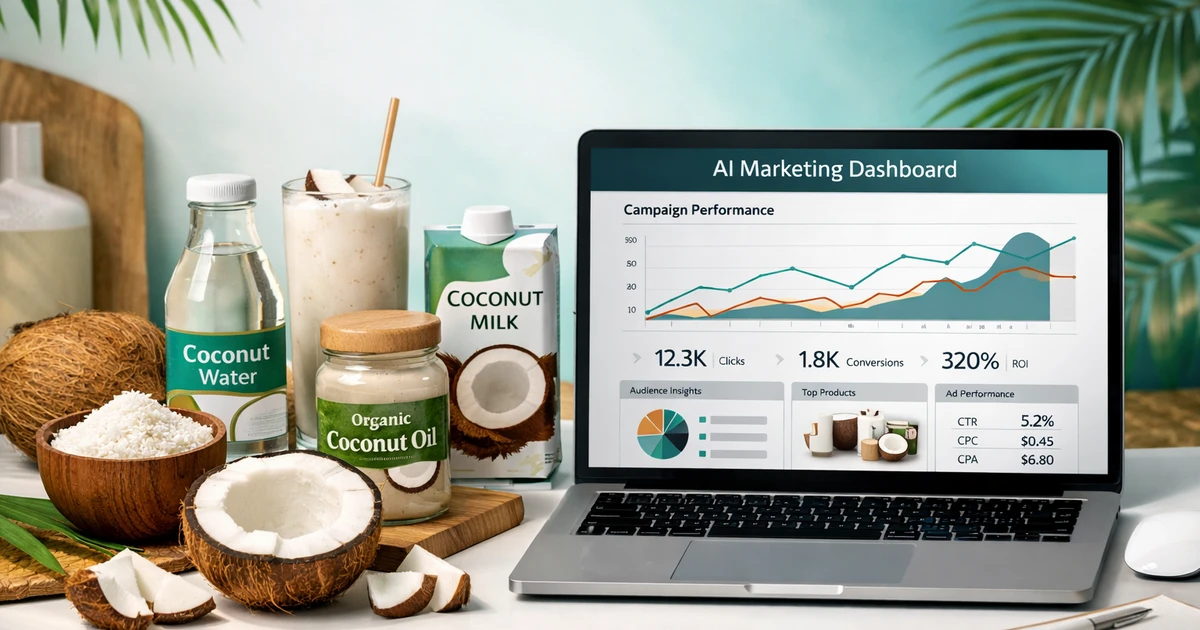
Coconut Marketing Guide for Modern Food Brand Growth
Coconut is no longer a niche ingredient. It now appears in drinks, snacks, skincare, cooking oils, desserts, and wellness products. For food brands, that creates opportunity and competition. The challenge is not simply selling coconut products. The real challenge is positioning them clearly, reaching the right buyers, and proving value across digital channels. This guide explains how coconut brands can use AI-powered marketing, data analytics, lead generation, and optimization to build demand and achieve high-quality results.
Key Takeaways
- Coconut brands win when they connect product benefits with specific buyer intent, not broad lifestyle claims.
- AI-powered data analytics can improve coconut marketing across SEO, paid ads, social media, and conversion funnels.
- Strong lead generation depends on clear messaging, credible proof, and tailor-made campaigns for each audience segment.
Coconut Market Positioning for Better Food Brand Marketing
Successful coconut marketing starts with a sharp position that explains who the product serves, why it matters, and how it fits into everyday use. Brands should avoid generic tropical messaging and instead connect coconut products to clear purchase occasions, dietary preferences, quality standards, and measurable customer needs across retail and online channels.
Many coconut brands rely on the same visuals and phrases. They show palm trees, beaches, and wellness cues. That can create recognition, but it rarely creates differentiation. A better approach starts with a specific position.
For example, a coconut water brand might focus on post workout hydration. A coconut milk brand might target plant based cooking. A coconut oil brand might focus on clean label baking. Each angle speaks to a different buyer, channel, and search intent.
Use data analytics to identify which benefit drives demand. Search data, sales history, reviews, and social comments can reveal what customers actually value. If buyers mention texture, sugar level, recipe use, or sourcing, your messaging should reflect those needs.
Food brands can also learn from adjacent categories. The Maple Syrup Marketing Guide for Modern Food Brands shows how a simple ingredient can become a premium product when brands clarify origin, use case, and audience.
Credibility matters too. If you discuss nutrition, verify details through trusted sources such as USDA FoodData Central. If you discuss global production, review agricultural context from FAOSTAT. Accurate claims protect trust and support long term optimization.
Build Coconut Product Demand With Audience Segments
Every coconut product serves more than one audience, but each audience needs a different message. A shopper buying coconut water for hydration, a parent buying coconut snacks, and a chef buying coconut milk all respond to different proof points, formats, channels, and offers during the buying journey.
Segmenting your audience turns broad interest into precise campaigns. It also helps your team avoid wasted spend. Instead of asking, “Who likes coconut?” ask, “Who has a reason to buy this product now?”
Useful audience segments include:
- Health focused shoppers seeking simple ingredients
- Fitness buyers looking for hydration options
- Home cooks using coconut milk in recipes
- Vegan and dairy free consumers comparing alternatives
- Retail buyers looking for high demand product lines
- Hospitality teams sourcing bulk coconut ingredients
Each segment needs tailor-made messaging. A fitness buyer may care about electrolytes and convenience. A home cook may care about creaminess and recipe performance. A retail buyer may care about shelf stability, margin, and repeat purchase potential.
This is where AI-powered segmentation becomes useful. Your team can analyze search queries, website behavior, campaign performance, and purchase data. Then you can build content and offers around real demand patterns.
For example, a brand selling coconut chips could create different landing pages for snack buyers, lunchbox planners, and wholesale distributors. Each page should include relevant benefits, product images, reviews, and a direct call to action.
This approach supports stronger lead generation because every message feels more relevant. It also makes optimization easier. You can measure which audience converts, which offer works, and which channel deserves more budget.
Use AI-powered Coconut Campaigns Across Search and Social
AI-powered campaigns help coconut brands move faster by testing messages, finding keyword opportunities, analyzing customer behavior, and optimizing creative performance. The goal is not to automate blindly. The goal is to combine human brand strategy with intelligent systems that improve targeting, timing, content quality, and budget efficiency.
Search and social channels work best when they support each other. Search captures active demand. Social creates awareness and desire. For coconut brands, the best strategy connects both channels into one customer journey.
Start with search intent. A shopper searching “best coconut water after workout” is different from someone searching “how to cook with coconut milk.” One query suggests product comparison. The other suggests educational content. Both can lead to sales, but they need different content.
A strong coconut SEO plan may include:
- Product pages optimized for purchase intent
- Recipe content for discovery and education
- Comparison pages for shoppers evaluating options
- Blog posts answering ingredient and usage questions
- Retail or wholesale pages for trade buyers
Leadmetrics V3 supports this kind of strategy through AI-driven search engine optimization, helping brands improve visibility with structured planning and ongoing optimization.
Social media should then translate those insights into engaging creative. A coconut milk brand can show recipe videos. A coconut snack brand can show lunchbox ideas. A coconut water brand can test fitness, travel, and office refreshment angles.
For brands that need better channel execution, social media marketing can help align content calendars, campaign assets, and performance tracking.
The key is consistency. Your search content, paid ads, organic posts, and product pages should reinforce the same value proposition. When buyers see a clear message across channels, trust improves and conversion becomes easier.
Turn Coconut Interest Into Lead Generation
Traffic does not create growth unless it turns into measurable action. Coconut brands need conversion paths that capture leads, educate buyers, and move customers toward purchase. Strong lead generation depends on landing pages, offers, email flows, product proof, and clear calls to action matched to each audience segment.
Many food brands attract attention but lose buyers before conversion. The product looks appealing, but the next step feels unclear. That gap weakens lead generation.
A better funnel gives each visitor a simple path. A consumer may need a discount, store locator, recipe guide, or subscription offer. A wholesale buyer may need a product sheet, sample request, pricing form, or distributor conversation.
For coconut brands, useful conversion assets include:
- Recipe ebooks featuring coconut milk or coconut oil
- Sample request forms for retailers and cafes
- Product comparison guides for health conscious shoppers
- Email flows with usage ideas and social proof
- Landing pages for seasonal campaigns and bundles
Your funnel should match the buying cycle. Someone discovering coconut snacks may not purchase immediately. A short email series can educate them with taste ideas, customer reviews, and bundle offers. A retail buyer may need product specifications, case sizes, certifications, and margin information.
This is where automation becomes valuable. AI-powered systems can route leads, score intent, personalize follow ups, and identify which audience is most likely to convert. For deeper strategy, the AI lead generation guide explains how businesses can build smarter lead funnels.
The best funnels are not complicated. They are clear, relevant, and measurable. Every page should answer three questions: Why this product, why now, and what should the buyer do next?
Measure Coconut Growth With Data Analytics and Optimization
Optimization turns coconut marketing from guesswork into a repeatable growth system. By tracking search visibility, ad performance, content engagement, conversion rates, and customer value, brands can identify what works, remove waste, and scale campaigns that produce high-quality results across online and offline channels.
Marketing performance improves when teams measure the right signals. For coconut brands, vanity metrics can be misleading. Likes and impressions matter only when they connect to awareness, traffic, leads, or sales.
Useful metrics include:
- Organic rankings for coconut product keywords
- Click through rate on search and paid ads
- Landing page conversion rate
- Add to cart rate or sample request rate
- Email signup and repeat purchase rate
- Cost per lead for wholesale campaigns
- Revenue by audience segment or channel
Review these metrics weekly or monthly. Look for patterns. If recipe pages bring traffic but few conversions, add stronger product links. If paid ads generate clicks but no sales, test landing page copy. If wholesale leads convert well, allocate more budget to trade focused campaigns.
Data analytics also helps product teams. Reviews may reveal demand for smaller packs, less sugar, better resealable packaging, or new flavors. Marketing data can support product development, not just promotion.
For a broader testing approach, read the AI Powered Digital Marketing Test Guide for Growth. It explains how growth teams can test campaigns, learn faster, and make better decisions.
Leadmetrics V3 focuses on practical optimization. Instead of running disconnected campaigns, brands can use AI-powered insights to improve the full journey. That includes search, social, paid ads, lead generation, and conversion performance.
Conclusion
Coconut brands have strong growth potential, but success depends on clear positioning, audience segmentation, smart channel execution, and measurable optimization. With the right AI-powered strategy, food brands can turn product interest into demand, improve lead generation, and build campaigns that deliver high-quality results with greater efficiency.
Coconut marketing works best when it is specific, credible, and data led. Define your audience, match benefits to intent, build search and social campaigns, and measure every step of the funnel. Avoid generic claims and focus on real buyer needs. With data analytics and tailor-made execution, coconut brands can grow more efficiently across consumer and trade channels. To build a smarter strategy, explore Leadmetrics V3 tailor-made digital marketing strategies or book a demo.
Leave a Reply