Django Guide for AI Marketing Websites in 2026
Django is no longer just a developer preference. It can be a smart foundation for AI powered marketing websites that need speed, security, data analytics, lead generation, and continuous optimization. Business owners and marketing professionals need platforms that convert traffic into measurable pipeline. This guide explains how Django supports scalable digital experiences, where it fits into modern marketing stacks, and how to use it with tailor made strategies that deliver high quality results.
Key Takeaways
- Django helps teams build secure, scalable, and data ready marketing platforms.
- A strong Django setup can support SEO, automation, lead generation, and analytics workflows.
- The best results come when Django development connects directly to AI powered marketing strategy and campaign optimization.
Why Django Matters for AI Powered Marketing and Lead Generation
Django gives growth teams a structured Python framework for secure marketing websites, customer portals, landing page systems, and connected applications. Its value is not only technical performance. It helps teams connect campaign data, user journeys, conversion tracking, and backend workflows into one flexible foundation that supports measurable lead generation and optimization.
Django works well when a business needs more than a simple brochure site. It supports custom logic, user accounts, forms, dashboards, content workflows, and integrations with marketing tools. For example, a company can build a lead generation portal that captures enquiries, scores leads, routes them to sales, and sends data into analytics platforms.
The official Django documentation explains its built in tools for security, databases, routing, templates, and administration. These features help businesses reduce development time while keeping control over performance and scalability.
For marketing teams, the real value appears when Django supports AI powered experimentation. A custom Django application can track user behaviour, store campaign performance data, and connect with automation tools. This makes it easier to test pages, offers, forms, and content at scale. If your team is building a testing culture, this AI powered digital marketing test guide for growth offers a practical starting point.
Django Lead Generation Workflows That Convert
Django lead generation works best when every form, page, and workflow reflects campaign intent. Teams can customize questions, scoring, routing, and follow up logic instead of relying on generic templates. That control helps businesses improve conversion quality, reduce manual work, and turn website traffic into qualified pipeline with clearer attribution.
Django web development is valuable for lead generation because it gives businesses full control over forms, landing pages, user journeys, and data capture. Instead of relying only on preset templates, teams can build tailor made experiences that match campaign intent, audience segments, and sales qualification rules.
Lead generation depends on speed, relevance, trust, and follow up. Django can support each of these areas when built correctly. A fast landing page reduces friction. A smart form asks only the right questions. A secure backend protects customer data. A connected workflow sends qualified leads to sales without delay.
A practical Django lead generation system might include:
- Dynamic landing pages for different campaigns
- Custom forms with progressive profiling
- Lead scoring based on source, behaviour, and intent
- Automated routing to sales or CRM tools
- Data analytics dashboards for campaign optimization
This approach creates high quality results because marketing and sales teams can see which channels, pages, and offers generate real opportunities. It also supports long term optimization because every interaction becomes useful data.
Django also helps businesses avoid disconnected systems. When forms, customer data, and analytics sit in separate tools, teams lose visibility. A well planned Django application can connect these workflows into one reliable environment. For companies focused on automation, this supports faster decisions and stronger lead quality.
Page speed also affects lead generation. Think with Google reports that 53 percent of mobile site visits are abandoned when a page takes longer than three seconds to load. Django teams can use caching, database optimization, and efficient templates to protect conversion rates during active campaigns.
If your current marketing stack lacks this level of integration, explore Leadmetrics and its focus on tailor made digital marketing strategies that connect execution with measurable outcomes.
Using Django SEO to Improve Search Visibility
Django SEO improves search visibility when technical architecture supports helpful content, clean URLs, fast templates, metadata, structured internal links, and accessible pages. The framework gives developers and marketers room to build optimization into publishing workflows, so search performance can improve as campaigns, landing pages, and content libraries scale without losing control.
A Django website can perform well in search when developers and marketers work together. Developers should create clean URLs, fast templates, mobile friendly layouts, and reliable redirects. Marketers should plan keyword intent, content depth, internal links, and conversion paths.
Google provides clear guidance through Google Search Central, including recommendations for crawlability, page experience, and structured content. Django can support these needs with custom templates, sitemap generation, schema markup, and content management workflows.
Django SEO Foundations for Crawlable Pages
Django SEO foundations start with pages that search engines can access, understand, and trust. Clean routing, useful metadata, structured content, optimized images, and logical internal links help marketers scale content without technical debt. This matters because every campaign page should support both rankings and measurable lead generation outcomes.
Key Django SEO actions include:
- Use readable URLs for service pages and blog posts
- Create unique title tags and meta descriptions
- Generate XML sitemaps for important pages
- Add structured data where it helps users and search engines
- Optimize images with descriptive alt text and compressed formats
- Improve page speed with caching and efficient queries
Django also supports programmatic content when used responsibly. For example, a business with many service locations can create structured location pages with unique copy, data, testimonials, and offers. This can support website optimization without producing thin or repetitive pages.
A niche business can also use Django to organize vertical specific content. For example, a food brand could adapt lessons from this maple syrup marketing guide for modern food brands into structured campaign pages, seasonal landing pages, and product education content.
For businesses that want search visibility tied to revenue, Leadmetrics offers AI driven search engine optimization that combines strategy, execution, data analytics, and continuous improvement.
How Django Applications Support Data Analytics and Optimization
Django applications can become powerful data analytics engines when they capture the right events, store clean records, and connect marketing actions to commercial outcomes. This helps teams move beyond surface metrics and understand which campaigns, audiences, landing pages, and user journeys create real business value through continuous optimization.
Most marketing teams track visits, clicks, and form submissions. Those numbers help, but they rarely tell the full story. Django can capture deeper events such as logged in behaviour, product interest, repeat visits, quote requests, content downloads, and sales readiness signals.
This creates a stronger measurement layer. A business can connect campaign source data with website actions and CRM outcomes. That connection helps answer practical questions:
- Which landing pages create the best qualified leads?
- Which channels attract users who become customers?
- Which form fields reduce completion rates?
- Which content topics support pipeline growth?
- Which audience segments respond to specific offers?
Django Data Analytics for Better Decisions
Django data analytics helps marketing teams connect user actions with business outcomes. Instead of reviewing isolated reports, teams can track sources, behaviour, form quality, sales readiness, and revenue signals in one environment. This gives decision makers clearer evidence for budget allocation, campaign optimization, and higher quality lead generation.
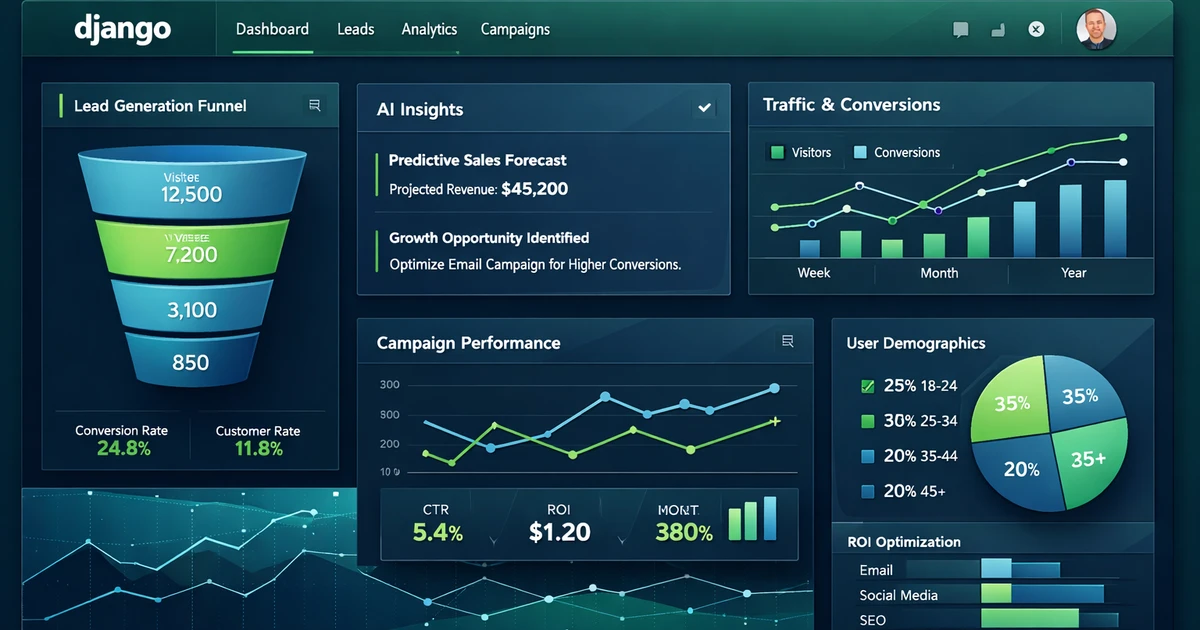
Django can also power internal dashboards. These dashboards help marketing leaders monitor lead generation, campaign performance, and conversion rates in one place. When paired with AI powered analysis, the platform can detect patterns faster and recommend optimization opportunities.
For example, a dashboard may reveal that paid search leads convert well only when users view a pricing page before submitting a form. The marketing team can then test new page layouts, calls to action, and retargeting sequences. This turns data analytics into practical action.
Research from McKinsey shows that organizations continue to increase AI adoption across business functions, including marketing and sales. That trend makes clean website data more important, because AI powered systems need accurate inputs to recommend useful optimization actions.
Growth teams that want a structured testing process can use this marketing test guide for AI powered growth teams to connect insights with repeatable experiments.
Security, Scalability, and When to Choose Django
Django is trusted for business critical applications because it includes mature security features and scalable architecture patterns. For marketing websites, this matters because performance, privacy, uptime, and trust directly influence conversion rates, user experience, and long term growth. It is strongest when a business needs custom workflows and reliable scale.
Security is part of marketing performance. If users do not trust a website, they will not submit forms, request demos, or share contact details. Django includes protections against common risks such as cross site scripting, cross site request forgery, and SQL injection when implemented correctly.
The OWASP Top Ten remains a useful reference for understanding major web application security risks. Businesses should still follow best practices, including secure authentication, regular updates, permissions management, and monitoring.
Security also has a measurable business impact. IBM reports in its Cost of a Data Breach Report that the global average cost of a data breach reached USD 4.88 million in 2024. For marketing teams collecting lead data, strong security is not optional. It protects trust, budget, and brand reputation.
Scalability also matters. Campaigns can create sudden traffic spikes. A Django platform can handle growth when teams use caching, database optimization, asynchronous tasks, and reliable hosting infrastructure. This protects the user experience during product launches, seasonal campaigns, and high demand periods.
Website optimization should cover both technical and marketing performance. A strong Django setup should improve:
- Page speed
- Mobile usability
- Form completion rates
- Tracking accuracy
- Content publishing speed
- Conversion path clarity
Django is a strong choice when a business needs a custom, scalable, and data connected website or application. It is especially useful when standard website builders cannot support complex workflows, advanced integrations, secure portals, or AI powered marketing automation requirements.
A small business may not always need Django. A simple website with a few pages can work well on a basic platform. However, Django becomes valuable when marketing needs become more advanced.
Choose Django when your business needs:
- Custom lead capture workflows
- Complex integrations with CRM or sales tools
- Secure user accounts or customer portals
- Large content libraries with structured data
- Advanced reporting and data analytics
- Automated campaign experiments
- Tailor made landing page systems
Django is also useful for businesses that want ownership. Many website builders limit what teams can customize. Django gives more control over architecture, data, user experience, and optimization. That control can create a competitive advantage when your marketing depends on speed and precision.
The key is strategy. Django alone will not create growth. It needs clear goals, customer insight, content planning, and conversion measurement. When development aligns with AI powered marketing execution, businesses can build platforms that attract, convert, and improve over time.
Businesses that want this connected approach can review Leadmetrics services for AI powered lead generation and full funnel optimization.
Conclusion
Django can be a powerful foundation for AI powered marketing when businesses use it with clear strategy. It supports secure development, lead generation, data analytics, Django SEO, and continuous website optimization. The strongest results come from connecting technical architecture with campaign planning, content, automation, and measurement. If your business needs a tailor made digital platform that delivers high quality results, now is the time to act. Book a demo with Leadmetrics to explore a smarter growth system for your next stage.
Leave a Reply